

Back
E-commerce


E-commerce
How Saving a Euro Today on Your E-Commerce Shop Can Cost You Double Tomorrow
It’s no secret that not all retailers in 2024 can claim better or more profitable years after reviewing the preliminary sales results from the previous year. Sales through e-commerce channels are even more disappointing, still far from returning to the “golden era” of COVID-19 times.
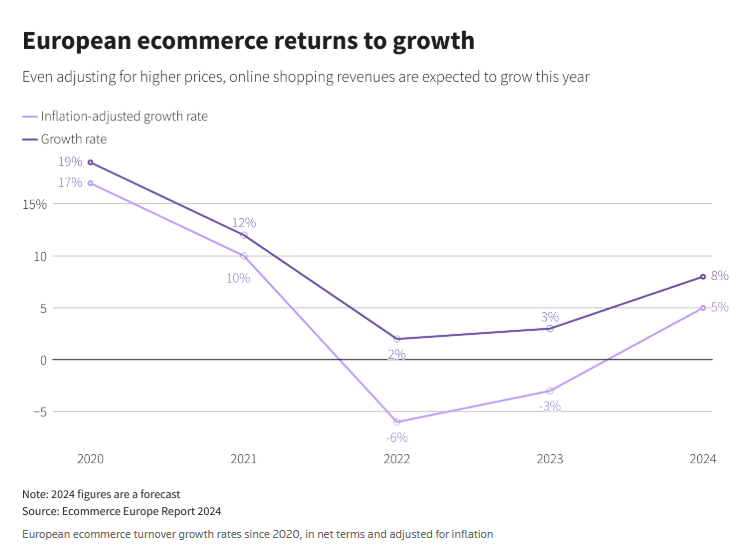
Source: Reuters – Online shopping returns to growth in Europe amid fierce competition
What happens in such cases? We look for cheaper ways to build e-commerce systems, recalculate budgets, and cut costs at the expense of functionality. What kind of traps might we fall into today by acting carelessly? Why will every euro saved today on hourly rates or choosing a cheaper contractor cost double or triple two years later?
What is this “quality” that developers and IT solution providers discuss when I’m a project manager working on e-commerce systems? I have to choose a platform and pick a contractor, but how do I avoid mistakes when trying to save? How can I evaluate which contractor to choose when they all seem the same, and only the price differs?
For many years, I’ve been advocating and educating my clients about the importance of code quality. And they often don’t understand me. It’s difficult to explain as a technical person, but I’ve found an analogy that resonates with clients unfamiliar with IT systems, their development, and the associated risks.
Imagine this scenario: today, you create your e-commerce store (or any other IT solution) and want to add a new feature. Your contractor estimates the task will take five hours. You think about it and decide it’s not urgent. You’ll wait until summer.
In the summer, you return, ready to invest, saying, “I’ve saved some money—let’s do it.” But the contractor informs you that after six months, the same feature now costs not five hours but eight or even nine. What happened? How could the price go up when it’s the same task?
This seemingly small difference of three hours reflects a lack of quality—something you don’t pay for and cannot measure. Now, imagine this happening with every task in the future. Each task becomes slightly more expensive—by 10–15%. And with every addition, the costs keep rising.
If you’re doing one phase of work, say 50 hours a month, a five-hour increase means 60 additional hours yearly. If this is 50 EUR an hour, it equals 3000 EUR yearly. Two or three years sum up to 6000 or 9000 additional budget for features, not bugs. Now, imagine that this escalation happens with every extra feature you implement. Each year, costs increase further.
Eventually, you find yourself in a position where, three years later, adding a new language to your e-commerce platform—which initially cost three hours—now takes 15 hours. Seems unfair? That’s because it is!
The best-case scenario is needing a “general overhaul,” which costs extra to fix issues accumulated over the years so that new features can again cost what they should.
In the worst-case scenario, you’ll need to redo the entire project, writing off 2 to 3 years of work as sunk costs that created no value.
When choosing a contractor with a lower hourly rate or less expertise, clients often calculate only the initial development costs. When they lack knowledge about how to evaluate contractors—and when they all seem the same—price often becomes the deciding factor. But saving today means paying more in two years for every additional task, as my example illustrates.
That’s why, during challenging times like the past year, when sales revenues fail to satisfy shareholders and sales managers need to roll up their sleeves, you must weigh your options carefully. Instead of choosing the cheapest contractor, invest slightly more to ensure that your spending today won’t be wasted. That’s the guarantee of quality.
The essence of a good IT solution and “quality” is that, whether today or five years from now, adding a new language—which typically takes only a few hours or a simple configuration—shouldn’t become an insurmountable 20-hour task.
This is just a visual calculated example of an imaginary situation.
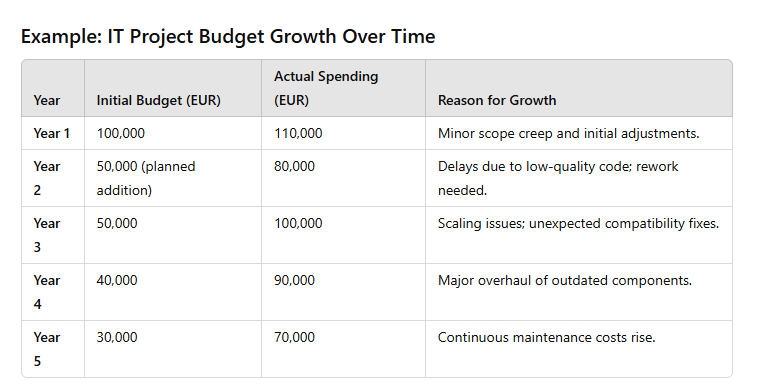
Unfortunately, such situations are not uncommon. I’ve written about them and shared examples on LinkedIn five years ago. In technical audits of PrestaShop stores conducted in recent years, we’ve answered similar questions from clients:
“Why does every feature cost me more?” they ask.
The answer is simple: at some point, the contractor “cut corners.” They quickly artificially reduced the hours required by programming and neglected proper processes. They did what was “faster.” What should have been managed with a simple setting adjustment was skipped or bypassed. And now, you either keep patching the fragile structure or redo it correctly, which inevitably means starting over.
I urge clients not to fall into the trap of cheap solutions during challenging times. Assess the risks of choosing contractors with lower hourly rates and less expertise. Otherwise, you may pay double in two years for what should already work.
Every euro you spend and invest in your e-commerce system today should generate significant returns and create value—not the opposite. By choosing contractors who deliver quality services and don’t cut corners, you can be confident that your e-commerce store or other IT solution will remain scalable, functional, and successful in driving sales.
Why Choose Us?
We are e-commerce professionals and building PrestaShop online stores since 2008.
We Solve Your Business Problems
Fast, Scalable, High-Quality Code
Human-Centered UI & UX
24/7 Technical Support
No e-shop is useful without understanding the business behind it. We analyze internal processes, define customer profiles, conduct competitor research, and set measurable goals to ensure success in the omnichannel world.
Every part of an e-shop, from integrations to search and checkout, must work seamlessly. Our experienced developers ensure fast, scalable, and high-quality code for optimal performance.
High conversion rates are achieved through strategic information architecture and exceptional design. Our expertise in UI/UX ensures a seamless connection between your business and your customers.
E-commerce is a constantly evolving system that requires 24/7 technical support and quick response times. Our support agreement ensures a 1-hour reaction time to critical bugs.


Why Choose Us?
Thinking about a new project? Let's make it happen!
Start now
