

Back
E-commerce

E-commerce
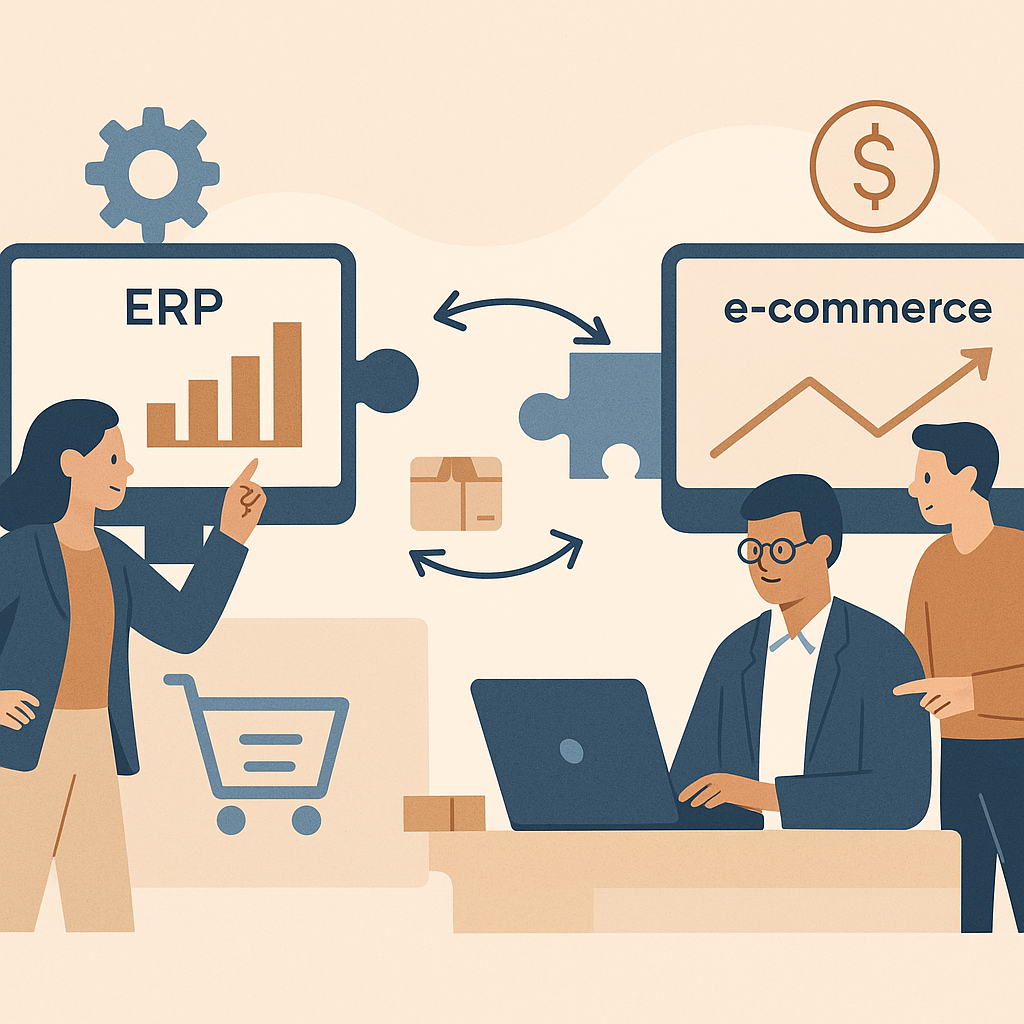
Collaboration Between eCommerce and ERP: How Their Synergy Helps Not Only Save but Also Earn
Enterprise Resource Planning (ERP) systems have experienced a resurgence in recent years. In particular, Lithuanian businesses are modernizing their ERP systems, investing heavily in new user interfaces, expanded functionality, and various integrations. Today, almost no business operates without an ERP system integrated with its eCommerce store. Lithuanian entrepreneurs have embraced this product and service sales channel, are actively using it, and continue to develop it further.
But what are the main problems when trying to digitize business processes? What challenges do companies face when uniting these two critical areas — ERP and eCommerce? What must business owners know to make integrations not just functional but also profitable?
These questions are answered by Raimundas Vaičiulis, who has 30 years of experience developing ERP systems and currently leads the TSM product, and Ričardas Šmaižys, founder of the “PrestaRock” team, which has been developing eCommerce systems for over 15 years.
What are the main challenges you face when clients request eCommerce development and its integration with accounting systems?
Ričardas: The biggest problem we encounter is that clients often don’t have software prepared to communicate with other systems over the network using standard protocols (like Web Services). In such cases, each integration — even if it’s with the same ERP — becomes a unique project. This dramatically increases the cost, both on the ERP side and ours. Unfortunately, we still see many such systems.
Raimundas: We don’t face this issue because we follow best integration practices, and we’ve long learned how to avoid the common “pitfalls.” This means we don’t need to experiment at the client’s expense. The real issue arises when the executor lacks the competence to understand a client’s business processes and can only interpret things from their narrow focus — i.e., the eCommerce side. We often become both implementers and educators for third parties, helping them understand how real business processes should function.
How do you help clients avoid headaches when connecting ERP to eCommerce?
Raimundas: We work with trusted partners who not only know our system but also have strong expertise in their own domain. For example, collaborating with Ričardas and the PrestaRock team, we often understand each other’s needs even between the lines. As a result, the integration becomes faster and smoother for the client — and without stress.
Ričardas: I agree with Raimundas. Our tried-and-tested collaboration and previously implemented solutions ensure satisfaction with both systems. Imagine if ERP and eCommerce providers kept redirecting the client back and forth, trying to avoid responsibility. For a client already overwhelmed with daily operations, this would create unnecessary stress. Our close cooperation between specialist teams helps eliminate that problem entirely.
What solutions do your clients appreciate the most?
Ričardas: In eCommerce, the “OmniChannel” approach to sales, marketing, and customer service has become the standard. In practice, this gives the client a seamless brand experience, no matter which channel they use to purchase a product or service. This means a company’s distribution, marketing, and communication channels are integrated — whether a customer shops via desktop, mobile, or in-store, their experience remains smooth.
For instance, we have integrated major retail chains where loyalty programs work both at checkout and within accounting systems. Another example: gift vouchers are a massive challenge for many POS systems when bought online and used in physical stores — our solution handles that.
Raimundas: Our TSM system has been recognized for offering not only advanced technology but also flexibility to meet unique client needs. We’ve successfully implemented many complex projects where everything — from order management to loyalty programs and gift vouchers — runs smoothly within one integrated system.
We’ve also completed multi-platform projects where clients operate several eCommerce channels simultaneously, each with its own assortment, pricing, and inventory. This ensures full automation and significant resource savings.
Is your solution suitable for B2B self-service?
Raimundas: Yes, we offer a B2B platform that operates independently from eCommerce and allows businesses to manage operations efficiently. The system ensures centralized control over orders, clients, and inventory, and enables customers to view real-time pricing, order history, and stock levels on their own. Thanks to its flexibility, it’s ideal for both large enterprises and smaller companies. Our B2B platform is fully integrated with other TSM modules, avoiding data duplication and saving time.
Ričardas: We integrate B2B solutions directly into the eCommerce store, helping reduce costs. One store becomes a single solution — for both retail “shelf” customers and sales reps who want to actually sell rather than just manage accounts. Our integrated B2B solutions — together with our partners’ ERP — support features like payment deferrals, full invoice history, personalized real-time pricing (not just static price lists), and many more functionalities.
The golden question every business interested in your solution will ask: how much does it cost?
Raimundas: We can only provide a precise cost once we’ve completed a needs analysis based on the client’s business goals, expectations, and system outlook. Then we recommend the most effective solution to improve performance and reduce costs.
Ričardas: Many of our clients have realized that our integrated solutions cost less than the competition — simply because we already have pre-built, tested solutions that can be implemented immediately for the client’s benefit. It’s only a matter of aligning expectations, just as Raimundas said.
Raimundas: And perhaps what’s most valuable — through our partnership, clients receive not just technical solutions but also expert advice. This drastically shortens the time required to find the right solution and gives them a competitive edge. We aim to solve every challenge together and find the best result. Clearly, combining our expertise and teamwork is one of our strengths — and our clients value it.
Why Choose Us?
We are e-commerce professionals and building PrestaShop online stores since 2008.
We Solve Your Business Problems
Fast, Scalable, High-Quality Code
Human-Centered UI & UX
24/7 Technical Support
No e-shop is useful without understanding the business behind it. We analyze internal processes, define customer profiles, conduct competitor research, and set measurable goals to ensure success in the omnichannel world.
Every part of an e-shop, from integrations to search and checkout, must work seamlessly. Our experienced developers ensure fast, scalable, and high-quality code for optimal performance.
High conversion rates are achieved through strategic information architecture and exceptional design. Our expertise in UI/UX ensures a seamless connection between your business and your customers.
E-commerce is a constantly evolving system that requires 24/7 technical support and quick response times. Our support agreement ensures a 1-hour reaction time to critical bugs.


Why Choose Us?
Thinking about a new project? Let's make it happen!
Start now
